A list of the day’s events can be a useful record. It tells you where you went, what you did, and who you saw. But when an entry feels flat to you, another question may help: what was it like to be me in that moment?
You can add that perspective without turning every page into a deep investigation. Choose one event and spend a little time with it. A few extra sentences may be enough to capture what you wanted, what surprised you, or what you still do not understand.
Choose one moment to stay with
Read your recap and notice which part draws your attention. It might be the most enjoyable moment or a tiny exchange that kept coming back to you. Write a short description of what actually happened before adding your interpretation.
Include enough detail that you can picture it later: the setting, the words you remember, and what you did next. When you are unsure of someone’s exact words, describe the conversation in your own language instead of treating a guess as a quotation. You are creating a record of your experience, with room for the limits of memory.
Separate the event from your reading of it
Try writing two sentences: “What happened was…” and “The meaning I gave it was…” This can help you notice where an observable event ends and your explanation begins. Both belong in the journal, but they are different kinds of information.
You can then ask whether another explanation is possible. You do not have to force yourself into a cheerful interpretation or dismiss your first reaction. Simply leave room for what you do not know. The other person’s intention may remain unclear, while your response is still worth describing.
Example entry: My friend took a long time to reply to my invitation. I started wondering whether she wanted to come at all. I do not know why she has not answered yet. I do know that I was looking forward to seeing her, and waiting felt harder than I expected.
Ask what you hoped for in that moment
Instead of searching immediately for a lesson, ask what you wanted. Maybe you hoped to feel included, to finish something, to be understood, or to have an hour with no demands. Write the answer as a possibility if you are still figuring it out.
You can also notice what felt good. A relaxed conversation might show you that you enjoy being with people who leave space for silence. Finishing a small project might feel satisfying because it gave an idea a real shape. An entry can explore pleasure and curiosity as carefully as disappointment.
- What was I hoping would happen?
- What part felt especially important to me?
- What do I know, and what am I still guessing?
End where the thought naturally ends
You may reach a small next step: ask a question, make a plan, or give yourself more time before deciding. Keep it concrete and within your control. “Ask whether Saturday works” is easier to act on than “Fix all my friendships.”
You may also finish with a question or a clearer description. That is a complete entry too. You do not need to resolve the feeling, explain your whole personality, or turn a difficult afternoon into something inspiring. Some days, a more accurate sentence is enough. If you feel finished, stop and return when you have something else to add.
Continue the thought with an AI journal friend
After writing an entry, you may want another perspective on a question you have not settled. Ying Journal’s virtual friends respond to your diary with different personalities, and you can ask a follow-up question to continue the conversation.
For the example of taking a longer walk home, try asking, “Which part of that evening did I want more of?” Then compare the reply with your own reading of the moment. AI replies are generated and can miss context; decide which ideas fit your experience and leave the rest.
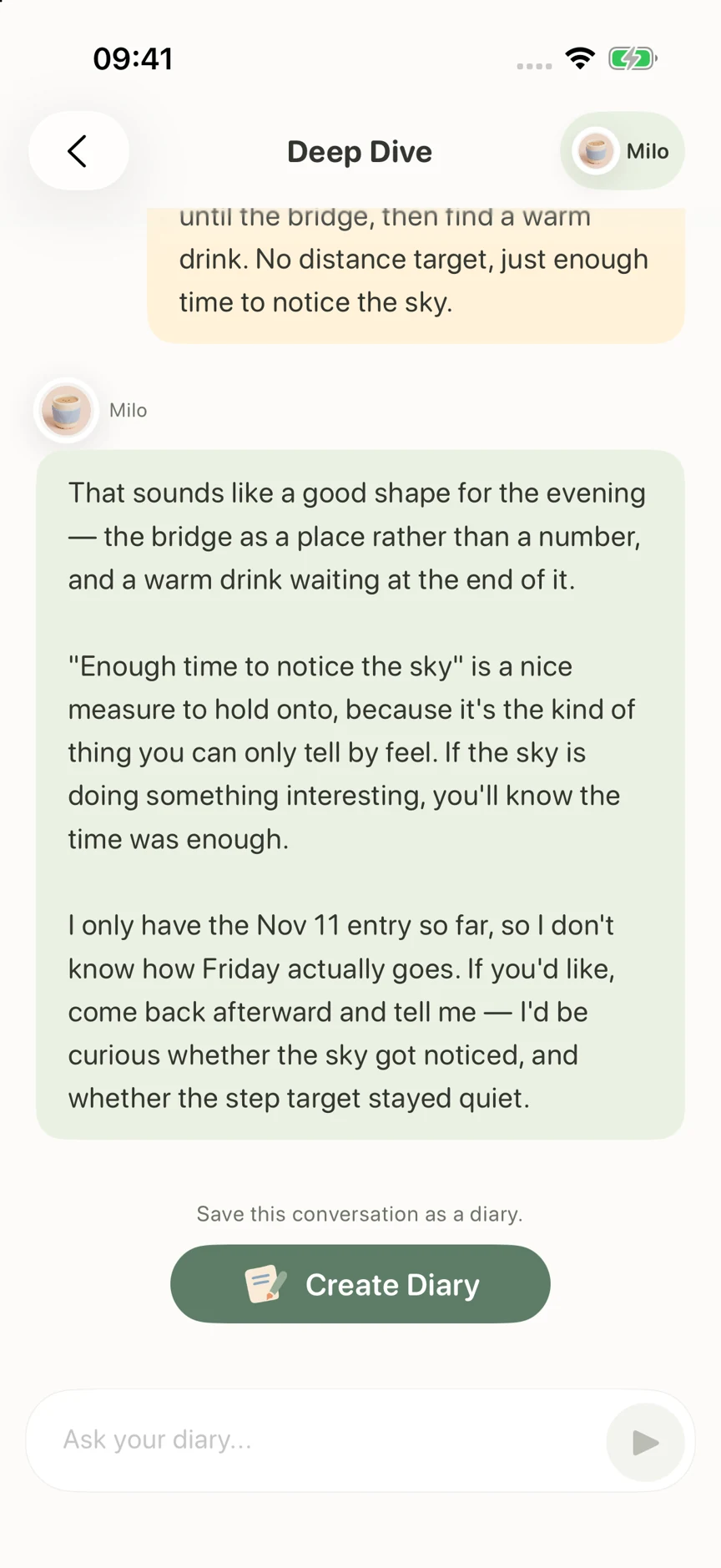
What might I be overlooking about this moment? What would I ask a friend to help me think through?
A small start, today.
Pick one moment from today and write four lines: what happened, what you made of it, what you hoped for, and one question or small next step.

A LITTLE PLACE FOR YOUR EVERYDAY
Give a thought a little more room.
Save a diary entry in Ying Journal, read a virtual friend’s perspective, and ask the next question that matters to you.